
Good Systems Scholar Explores How AI Affects Creativity and Ethical Collaboration
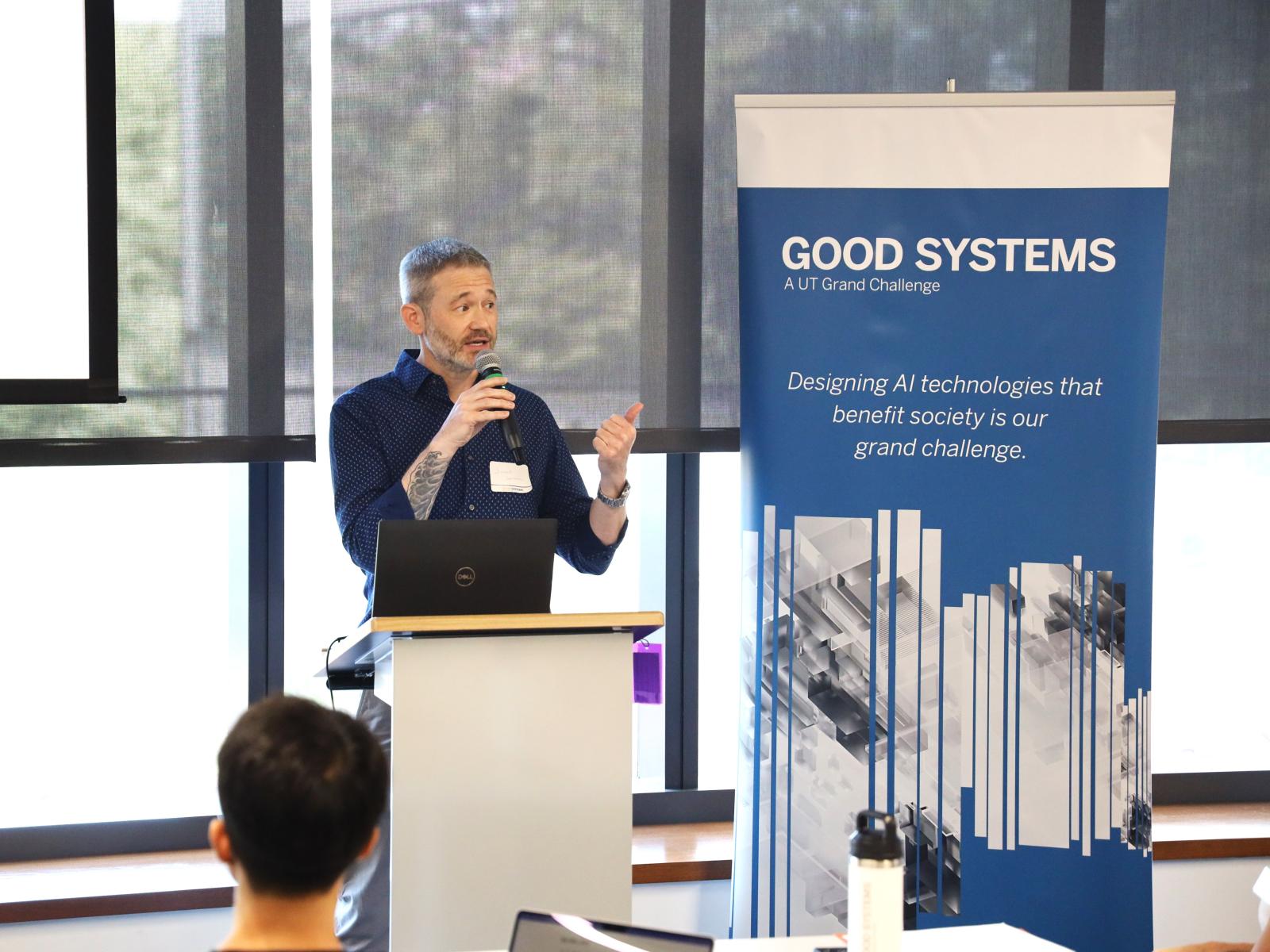
As AI technologies reshape everything from daily routines to creative industries, Good Systems is examining those impacts from multiple angles. Last year, the initiative launched cross-cutting themes to connect its six core research projects and explore questions that span technical, ethical and social domains.
One of the scholars continuing that work is Moody College of Communication postdoctoral fellow Jared Jensen, whose Knowledge, Generative AI and Power theme focuses on two interweaving concepts: how interdisciplinary teams pursue “ethical AI,” and how generative technologies are transforming creative labor and power dynamics.
To understand how research teams define and apply ethics in AI development, Jensen conducted interviews with 30 Good Systems researchers and reviewed their project documents to analyze what he calls ethical boundaries — the shifting limits that determine which ethical issues a project emphasizes, and which remain outside its scope. “We all start with broad, aspirational frameworks, but as projects evolve, those frameworks become bounded,” he said. “Recognizing those boundaries helps us understand how knowledge and ethics are actually organized in collaborative AI work.”
His second research stream investigates how generative AI alters creative production. Working with Good Systems’ Dhiraj Murthy, Sharon Strover and Sam Baker, Jensen conceived generative AI as a form of automation that draws from and recombines existing creative content while increasing economic uncertainty for creative workers. “By studying both ethical boundaries in research and power dynamics in creative industries,” Murthy said, “Jared connects the internal and external dimensions of responsible AI — how we build it and how it reshapes society.”
Jensen and his team also explore the concept of “distanciation,” the growing gap between creators and their work as technology mediates the creative process. “I can sit down with a paint brush, make a painting and then I have a physical object,” Jensen said, “but if an object is mediated by a technology that draws on a bunch of different creative artifacts at once, what place does that put me in as a creative worker, and what does that mean?”
Jensen’s collaboration with Baker, an English professor, began when the two connected over their shared interest in creativity and technology. “That’s one of the brilliant things about this cross-cutting theme,” Jensen said. “We can collaborate across disciplines with different people and bring those different bodies of literature together.… You start answering questions in different ways.”
Over the coming year, Jensen plans to take his research into the field, studying how musicians navigate an AI-saturated creative landscape, a subject that has taken on new resonance with the recent success of an AI-written country hit.
As a musician himself, Jensen says that background helps him connect with participants. “Not only does it complement my interests,” he said, “it also makes it a little bit easier in the sense that when I go into a music-oriented space, I know the language that they speak already.”