
Good Systems’ Outgoing and Incoming Chairs Reflect on 2025-26 and Look Ahead to 2026-27, the Final Year of the Grand Challenge
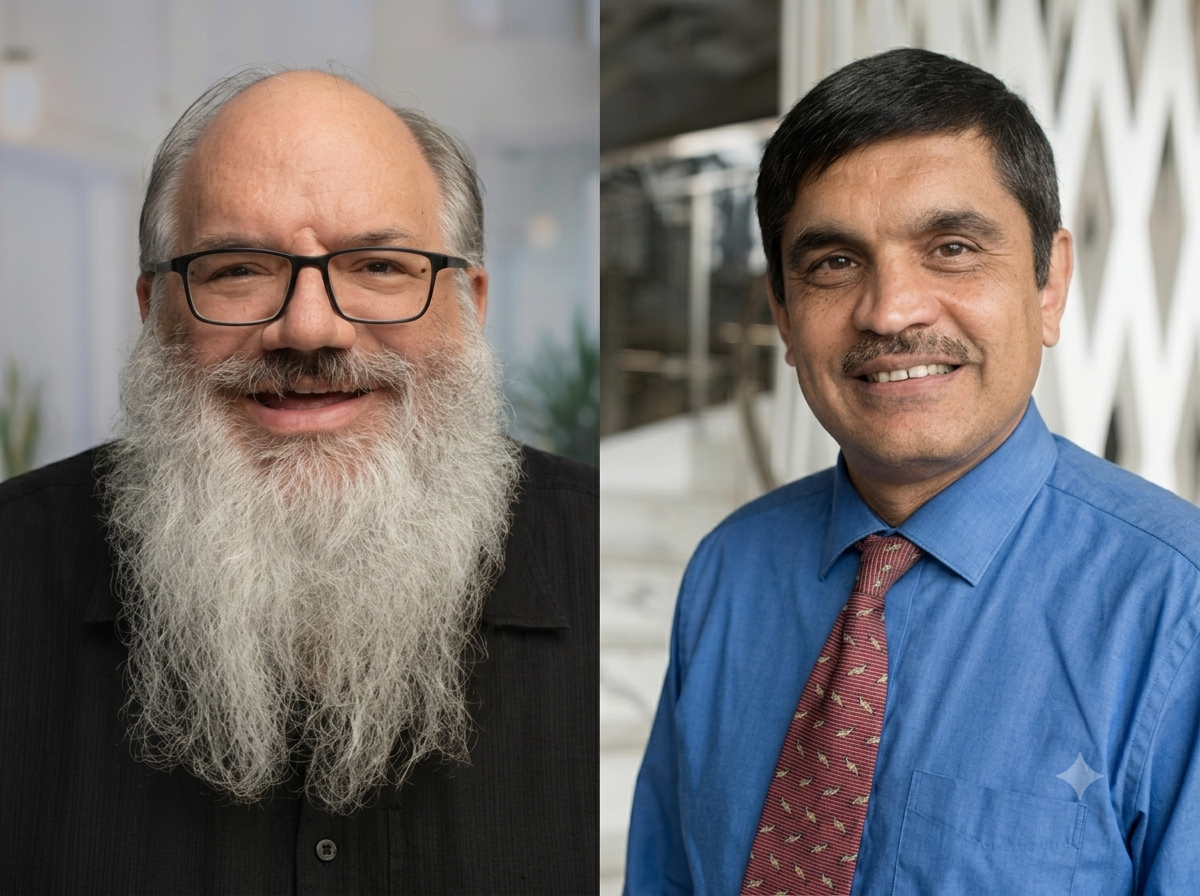
Good Systems would like to thank founding chair Ken Fleischmann for his leadership as chair of the Good Systems Executive Team in 2025-26. Fleischmann will continue to serve on the Executive Team. The grand challenge now welcomes Chandra Bhat as chair for 2026-27.
Read letters from Fleischmann and Bhat as they reflect on the past year and look ahead to the next.
From Our Outgoing Chair, Ken Fleischmann
When Good Systems launched seven years ago, the risks we set out to study still seemed abstract and distant. They are here now — in hiring, in health care, in classrooms — and addressing them requires understanding both AI and society. This year, our work was about showing what that understanding yields and building connections to carry us beyond the Grand Challenge.
Our six core teams converged on a single point: the effects of AI systems are shaped as much by society as by technology. Data and information play critical roles, as with surveillance footage, clinical decision-making and records of job performance. We found that how safe people feel around service robots depends on the robots' movement and who else is present, with implications for how people and robots adapt to each other over time. AI has the potential to protect us — improving pedestrian safety, worker safety and emergency response — but it also carries dangers, exemplified by over-reliance on AI companions.
I am proud of our strategic partnership with the Machine Learning Lab and Texas Robotics, which led to the inaugural Texas Symposium on Machine Learning, Responsible AI, and Robotics, an interdisciplinary event with 655 attendees hailing from industry, government, nonprofits and 19 UT colleges, schools and units. Ethical questions ran across the entire symposium, earning equal footing with technical advances.
We also convened a national virtual conference for several hundred researchers at other institutions. Our call for seed proposals drew 48 submissions and funded six new teams, bringing on board 24 researchers from 10 colleges, schools and units. And the Alliance for Interdisciplinary AI, which we founded, now brings together 30 researchers from 11 peer institutions who meet annually.
Good Systems continues to be a team effort, thanks to our researchers and students, our executive team, our external reviewers and advisory councils, the Office of the Vice President for Research, and Lea Sabatini and Stacey Kaleh, who convene and unify this community. I am grateful to everyone.
Chandra Bhat is the right leader for this moment. Our future is bright: the seed teams, the partnerships and the alliances we built this year will carry this work through our culminating grand challenge year and far beyond.
Professor Kenneth R. Fleischmann is the founding chair of Good Systems. He holds the Louis T. Yule Regents Professorship in Library and Information Science and serves as that department’s chair at the School of Information.
From Our Incoming Chair, Chandra Bhat
As I begin my term as chair of Good Systems, I am deeply grateful for the extraordinary community built over the past seven years and energized by the responsibility of helping shape what comes next.
We enter the final year of the Good Systems grand challenge at a remarkable inflection point. Artificial intelligence is advancing with extraordinary speed, bringing substantial benefits in productivity, discovery, decision-making and many other dimensions of human endeavor. Those benefits are real, and the possibilities ahead are enormous.
Yet the ubiquity of “AI” in our conversations should itself give us pause. At times, AI risks becoming a buzzword, a technology to be adopted simply because it is available, because competitors are adopting it or because no organization wants to be left behind. The pace of innovation can easily outstrip our willingness to ask harder questions about unintended consequences.
This is precisely why the vision behind Good Systems matters today. From its inception, Good Systems recognized that the challenge was never simply to build more capable AI. It was to ask a more fundamental question: How do we ensure that AI-enabled systems genuinely serve people and society?
Technological advancement and economic prosperity are important, but they are means, not ends. Ultimately, technology should help people live better lives. It should expand opportunity and human agency, strengthen communities, improve quality of life and contribute to greater well-being, happiness and joy. The direction of AI cannot be determined primarily by competitive pressures, organizational efficiency or the pursuit of private gain. What should guide us is whether AI makes life better for people, strengthens our communities and contributes to a better society.
Our final Grand Challenge year provides an opportunity to bring important research to fruition, broaden the reach of our seed-funded projects, deepen partnerships and community engagement, and translate our collective scholarship into insights that shape practice, policy and education.
But our task is larger than completing a grand challenge. It is to carry forward the ideas, interdisciplinary community, partnerships and values-driven approach that Good Systems has created. I look forward to working with the Good Systems community to make this final year not simply a culmination, but a foundation for the work that follows.
Professor Chandra R. Bhat is a founding member of the Good Systems Executive Team. He is the Joe J. King Chair in Engineering at the Maseeh Department of Civil, Architectural, and Environmental Engineering, where he teaches courses in transportation systems analysis and transportation planning.