
From wearable sensors that capture children's real-world experiences to guidance on the responsible use of AI, Kaya de Barbaro's work bridges developmental science and emerging technologies.

Children's development unfolds in the small moments of everyday life — during interactions with caregivers, routines at home and amid the many distractions and demands of daily living. Yet for decades, developmental scientists have relied on laboratory observations and questionnaires that capture only snapshots of these experiences.
As researchers increasingly turn to wearable technologies paired with machine learning and artificial intelligence to study children's real-world environments, new opportunities have emerged to understand development as it happens. But these tools also raise important questions about how to measure behavior accurately, ethically and responsibly.

These questions sit at the center of two recent studies by Whole Communities–Whole Health team member Kaya de Barbaro, an associate professor of psychology in the College of Liberal Arts who directs the Daily Activity Lab. Bridging science and engineering with developmental and clinical psychology, de Barbaro investigates the dynamic interactions that shape infant social and emotional growth. Together, her two studies highlight both the promise and the challenges of using emerging technologies to better understand children's social-emotional development.
"Before, when we wanted to study child development, we would bring in a mother and their child into a lab for 15 minutes in an empty room, and say, 'Okay, play as you normally would,'" de Barbaro said. "But that’s not what caregiving looks like in everyday situations. Children’s everyday interactions are their literal inputs for development."
Her research sits at the intersection of psychology, neuroscience and computer science. By utilizing wearable sensors, video and physiological data collection, she develops and critically evaluates computational methods, including AI-assisted tools, to identify meaningful behavioral patterns and interventions to support families.
Two recent publications illustrate this interdisciplinary vision: one uses all-day audio recordings to show that mothers' responses to infant distress vary considerably across everyday contexts, while the other offers practical guidance for researchers to critically evaluate and responsibly use AI tools that identify patterns of behavior.
De Barbaro's research also reflects the broader mission of Whole Communities–Whole Health: to understand health in the context of everyday life and return meaningful insights to the communities that make research possible. Building on studies of everyday caregiver-child interactions and the program’s support for research on algorithmic approaches to behavior detection, her work aims to process complex data more efficiently and accelerate the return of meaningful findings to participating families and communities.
Revealing the Complexity of Everyday Parenting
Spoiler alert: researchers have found that parenting looks different from moment to moment. In the maternal sensitivity to distress study published in Child Development, wearable audio recorders provided an unprecedented window into infants' daily lives, allowing researchers to analyze nearly full-day recordings from 38 family homes and examine how caregivers respond to their babies' fussing and crying.
Traditional assumptions often frame parental responsiveness or sensitivity to distress as a fixed trait — the idea that a caregiver is either inherently attuned to their child or they aren't. However, these new findings challenge the notion that caregivers can or even need to always be consistently responsive. Instead, the research demonstrates that maternal sensitivity is not a stable baseline, but a dynamic, context-dependent process that fluctuates throughout the day, shaped by the messy realities of everyday caregiving.
"For parents who feel like they must be 'on' all the time, or moms who feel guilty because they aren't responding all the time, this work shows that fluctuations in sensitivity are a normal part of caregiving," de Barbaro said.
"In everyday settings, parents are managing a lot, and it's very typical that availability for your child is going to go up and down," she added. "We see that occurring even in our most sensitive parents. I think that should bring some relief to caregivers who feel overwhelmed or stressed, or who feel guilty that they can’t be perfectly sensitive 100% of the time."
Picture a moment from everyday family life: A baby begins to cry during a quiet moment at home, and a caregiver responds immediately with soothing words or touch. Later that same day, that same caregiver may be juggling another child, household tasks or background media, responding differently amid competing demands. "The message is not that caregivers should ignore children's distress, but that real-world caregiving is variable and that this is actually quite normal," de Barbaro said.
These results also demonstrate the power of wearable sensing technologies to provide a richer and more realistic understanding of children's developmental environments. At the same time, they raise an important question: How can researchers analyze the enormous amounts of data generated by these tools at a larger scale?
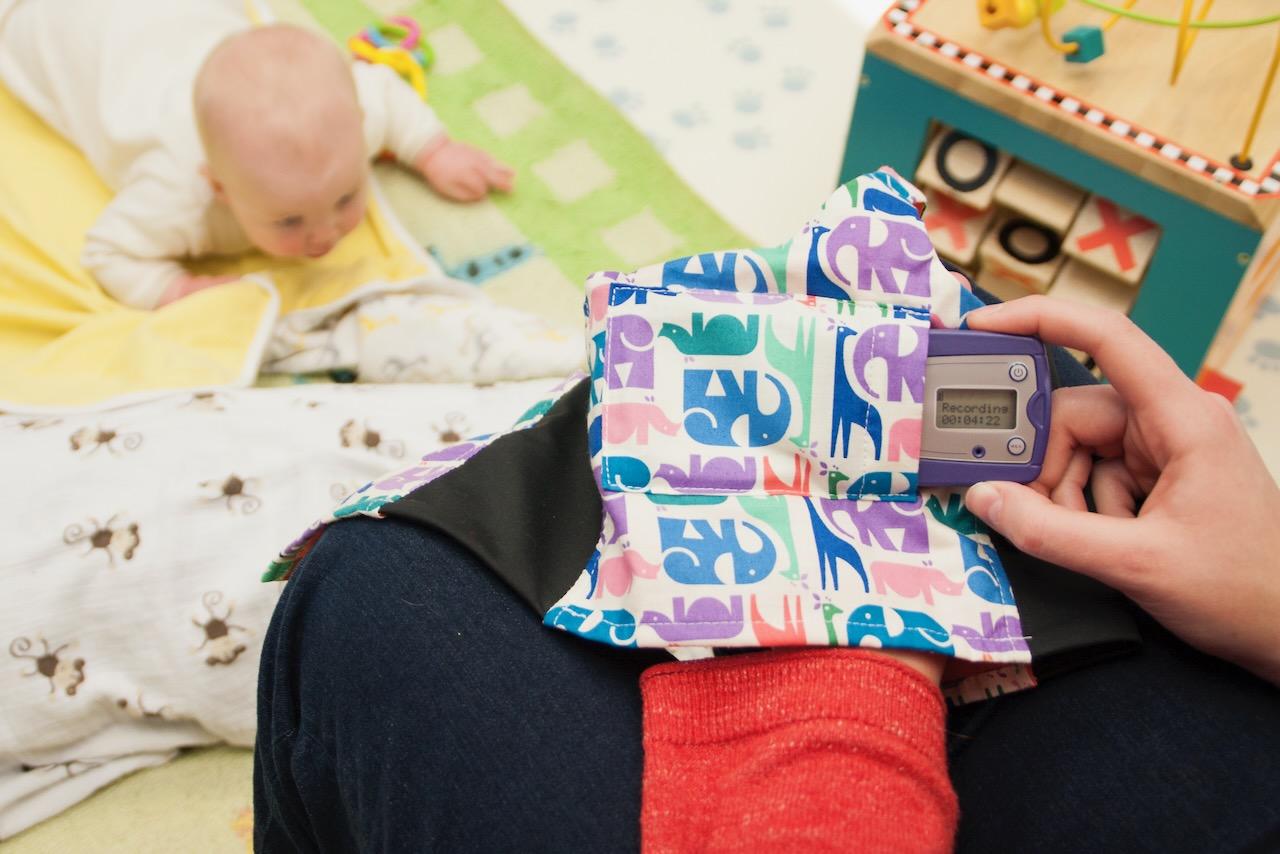
Behind the scenes, the maternal sensitivity project depended on extensive human annotation of thousands of moments from all-day recordings. A single infant can generate nearly an entire day's worth of audio data, capturing hundreds of moments of crying, soothing, play, and interaction. While these recordings provide an unprecedented window into children's everyday lives, they also create a challenge: no team of researchers can manually analyze every moment at scale.
"We work with audio and sensor recordings that can run up to 72 hours. It isn’t feasible for a student to comb through all of that by hand to find the meaningful moments," de Barbaro said. "That's where AI and machine learning make a real difference in child development research — they help us efficiently surface the patterns and events that matter."
This is where advances in machine learning and AI can become transformative. Automated systems could potentially identify crying episodes, conversational interactions, caregiver responses, and other behaviors across datasets too large for humans to code manually. However, automation introduces new risks.
New Tools, New Responsibilities
As developmental scientists increasingly turn to machine learning and artificial intelligence to identify patterns in behavior from wearable sensor data, researchers must ensure that these systems are accurate, ethical and appropriate for real-world use.
The second study, published in Developmental Science, addresses this challenge. To support the research field’s use of emerging technologies, de Barbaro and her UT co-authors — Anna Madden-Rusnak, a women's health research scientist, and Adela Timmons, an assistant professor of psychology — developed practical guidelines for evaluating and implementing AI-based behavior detection systems.
The recommendations emphasize careful interpretation of accuracy measures, awareness of limitations in model generalizability, ethical concerns about systematic bias, and the importance of interdisciplinary collaboration and community engagement. The authors note that models often perform differently across populations and contexts, that common accuracy metrics can be misleading and that systems developed under controlled conditions may fail in everyday environments.
Just as a person might struggle to understand a conversation in a noisy room, AI systems can falter when confronted with the complexity and unpredictability of real-world settings. The guidelines encourage researchers to ask not only whether an algorithm works, but when, where and for whom it works before using it to draw scientific conclusions.
Ultimately, the paper proposes that technological innovation must be matched by careful evaluation, ensuring that AI tools are reliable and appropriate for real-world use while advancing science in ways that respect the complexity of human experience. "Behavioral scientists and psychologists need to be part of building AI models and algorithms, along with the computational modelers," de Barbaro said. "Without expertise from both social sciences and engineering shaping the work, there's no way to know whether the model captures anything real about human behavior, the moments that actually matter and shape development.
"Developmental scientists understand that human behavior unfolds across multiple dimensions, multiple timescales and depends heavily on context. That knowledge helps models pick up on meaningful differences in behavior, which makes them more accurate and makes our research stronger. There is a lot of promise in that for how we do our work in the future."