
Planet Texas 2050 Co-Hosts Film Fest Dedicated to Climate Storytelling
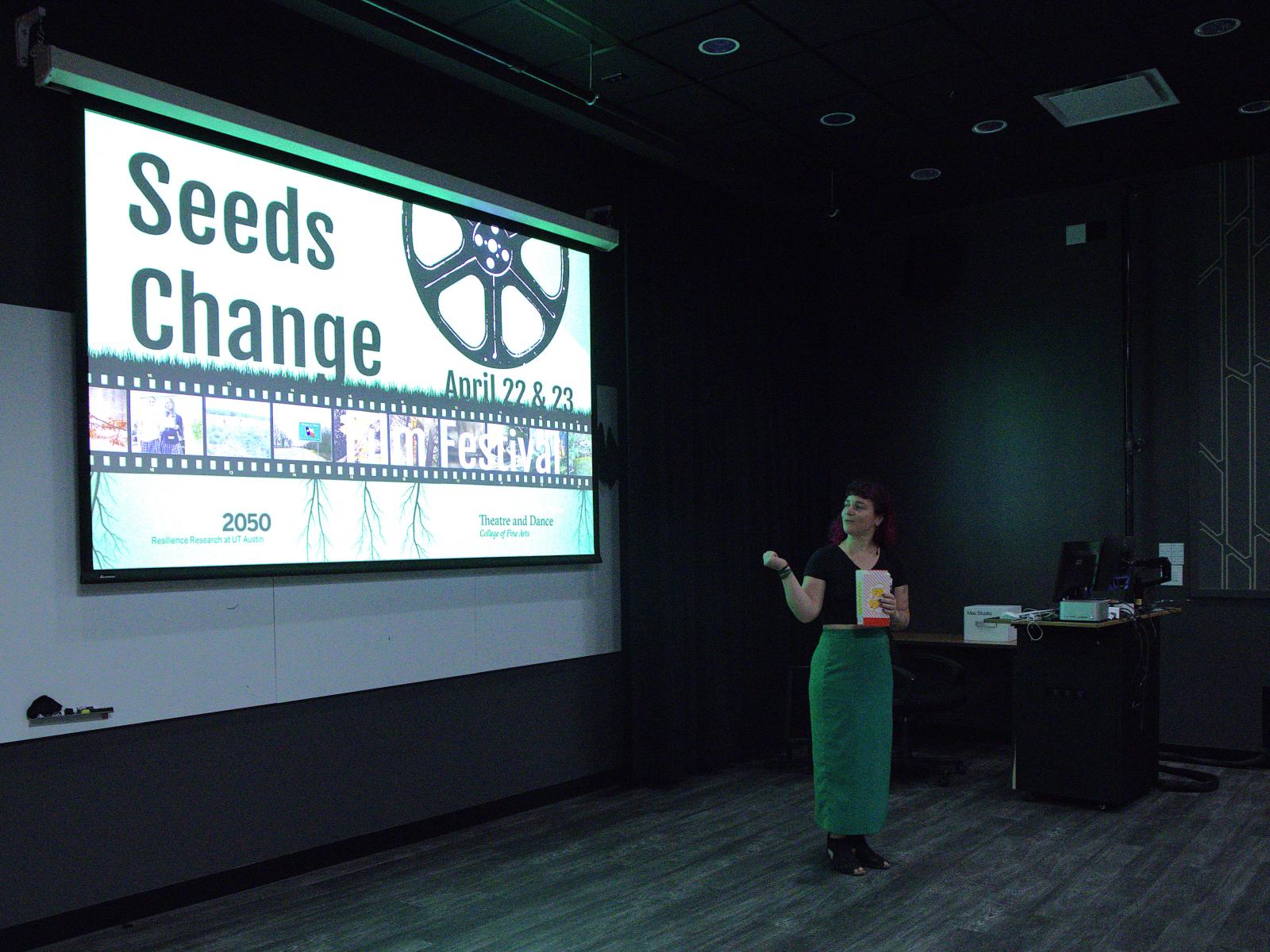
Earlier this spring, Planet Texas 2050 and the Department of Theatre and Dance co-hosted the Seeds of Change Film Festival, a two-day gathering of filmmakers, researchers, artists and community members exploring climate resilience through film. The vibes were warm and collegial. Popcorn was served.
Organized around two thematic screening blocks — Land and Water — the festival showcased more than a dozen short films before closing with a documentary, “Mālama Mākua,” which kicked off an overlapping conference, Futures Beyond Militarism. The Seeds of Change films reflected PT2050's conviction that fine arts are an essential component of adapting to life in a changing climate.
“I was thrilled by it, because... people connected to it in some way, and I thought that the film submissions that we got were really touching and beautiful,” said Kate Freer, an assistant professor in Theatre and Dance who helped organize the festival. “So, for me, it is really an affirmation that there's interest, there's work, there's artists and scientists and collaborators across many disciplines that are using film as a medium to investigate and communicate and create work about this really important topic.”
“Mālama Mākua,” which won the Audience Choice Award at the 2025 Hawaiʻi International Film Festival, follows a grassroots movement to reclaim a sacred valley in O’ahu from the U.S. military. It was co-written and produced by Laurel Mei-Singh, an assistant professor of geography and Asian American Studies and recipient of a Planet Texas 2050 + Humanities Institute Faculty Learning Community award in 2023.
All films from the festival program are available to watch via the links below.
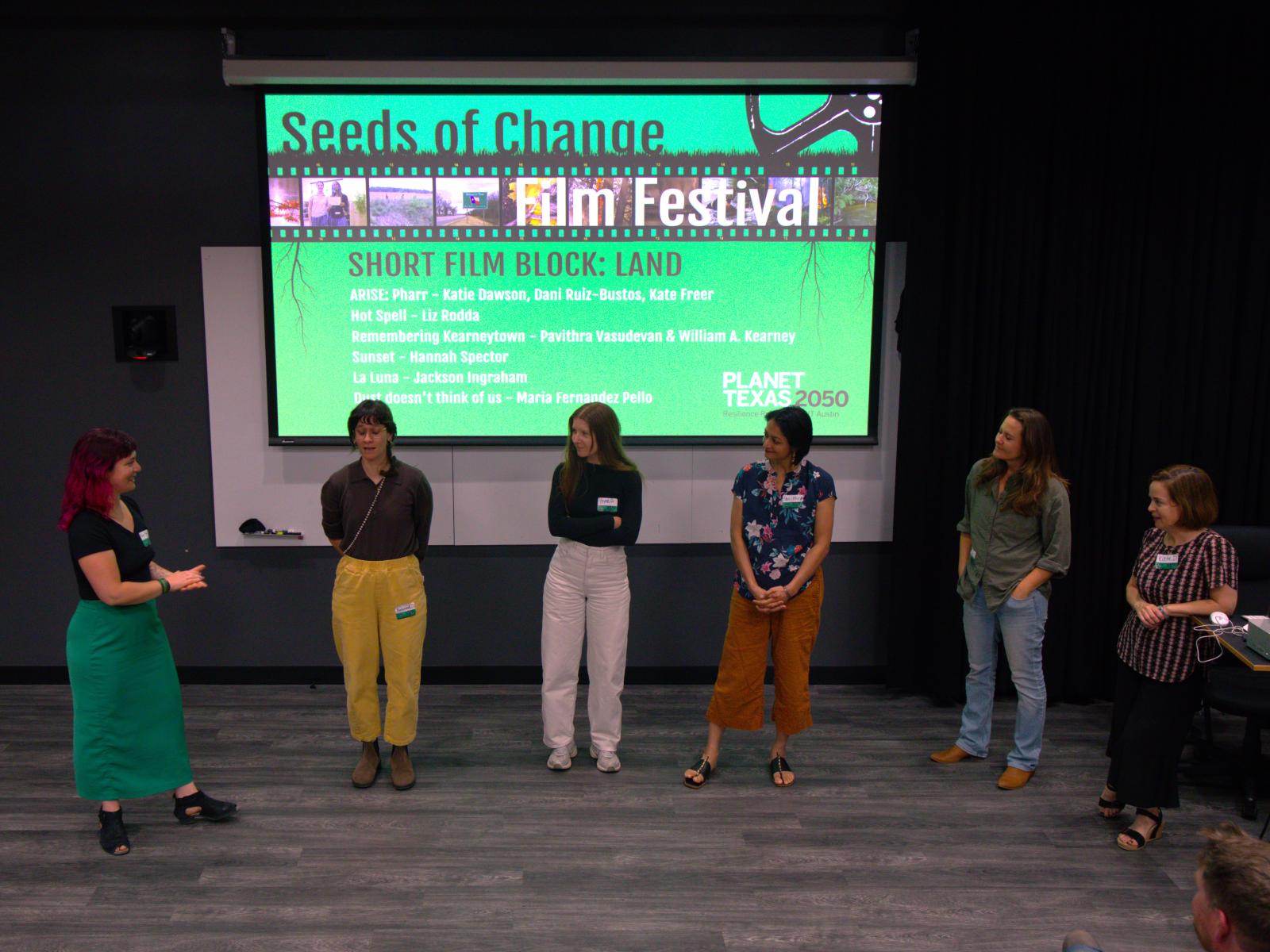
Session One: Land
Shot during her 2021 – 22 PT2050 artist-in-residency, mónica teresa ortiz’s short video poem traces the poet's personal relationship with Texas and climate catastrophe, from the Panhandle to South Texas.
Produced by La Cuna Center and Tree Monster, in collaboration with Central Basin Prescribed Burn Association and Texas Parks and Wildlife, this short documentary chronicles a work of “land art” in central Texas, in which a prescribed burn becomes both an ecological tool and a visual statement, reframing fire as an act of stewardship.
Texas State art & design professor Liz Rodda’s film is a meditation on heat and sun exposure shot in the west Texas desert, weaving site recordings, foley audio and found sound into a layered sonic environment that engages with the perceptual intensity of an arid landscape.
Inspired by a cemetery co-creator Flora Weil encountered while doing fieldwork in the Gobi Desert, this film mixes footage and speculation to challenge the assumed boundary between thinking life and "thoughtless" nonlife — dust, minerals, burial sites and all.
This meditative film by Hannah Spector, in collaboration with Valentine, Texas, is a quiet reflection on a mountain landscape drenched in the purple, pink and orange hues of a brilliant sunset.
Shot and edited by Pavithra Vasudevan, “Remembering Kearneytown” follows Rev. Bill Kearney, an assistant pastor in Warren County, North Carolina — known as the "birthplace of environmental justice" — on his quest for his community to reclaim its legacy of environmental justice and develop a healthy relationship to the environment.
This film by Katie Dawson, Dani Ruiz Bustos and Freer depicts the work of ARISE Adelante, a nonprofit organization based in the Rio Grande Valley that has been serving local communities for nearly 40 years.
Session Two: Water
Directed by Marcelo de Stefano, alongside collaborators from the lower Rio Grande Valley, this film spotlights Planet Texas 2050’s AI-Enabled Model Integration for Complex Decision Making project, which utilizes AI-enabled models to address cascading climate impacts while preserving the region's people, cultures and landscapes.
“Graybelt” is a video map of the Texas Colorado River, as seen through the eyes of New York-based artist Marie Lorenz, who navigated the river from Colorado City to the Gulf of Mexico in a boat she made herself.
Shot and edited by Tara Baker, “aqueous” features choreographer and dancer Rosemary Candelario, an associate professor of performance as public practice, on Denton, Texas, waterways, cultivating attention to water's seasonal, geologic and geographic presence in our lives.
Created by interdisciplinary artist and activist Ty Defoe of the Oneida and Ojibwe Nations, “Gifts For the River” is a celebration of the Chippewa River and the communities along its banks. It brings together artistic, musical, cinematic and environmental contributions to honor the intersections of nature, story, traditional ecological knowledge and community care.
This documentary short examines life around SpaceX's Boca Chica Beach launch site — set within a wildlife protection area — asking who benefits from interplanetary ambition and at what cost to the planet left behind. It was created and produced by the Gigacities Collective, an experimental art and journalism satirical group (tagline: “It’s not funny enough”) made up of UT’s Randolph Lewis and Craig Campbell, both from the College of Liberal Arts, and Florian Grundmüller of the University of Göttingen in Germany.
An older woman shares a quiet telepathy with the Neches River in this contemplative film written and directed by Austin-based artist Katy McCarthy.
Closing Screening
Mālama Mākua (2025) Winner of the Audience Choice Award at the 2025 Hawaiʻi International Film Festival, this 50-minute documentary follows the ongoing movement to return military lands at Mākua to Native Hawaiian stewardship, connecting local struggle to global movements for demilitarization and environmental justice.