
A Norwegian statistician finds new applications for his research in climate resilience at Planet Texas 2050
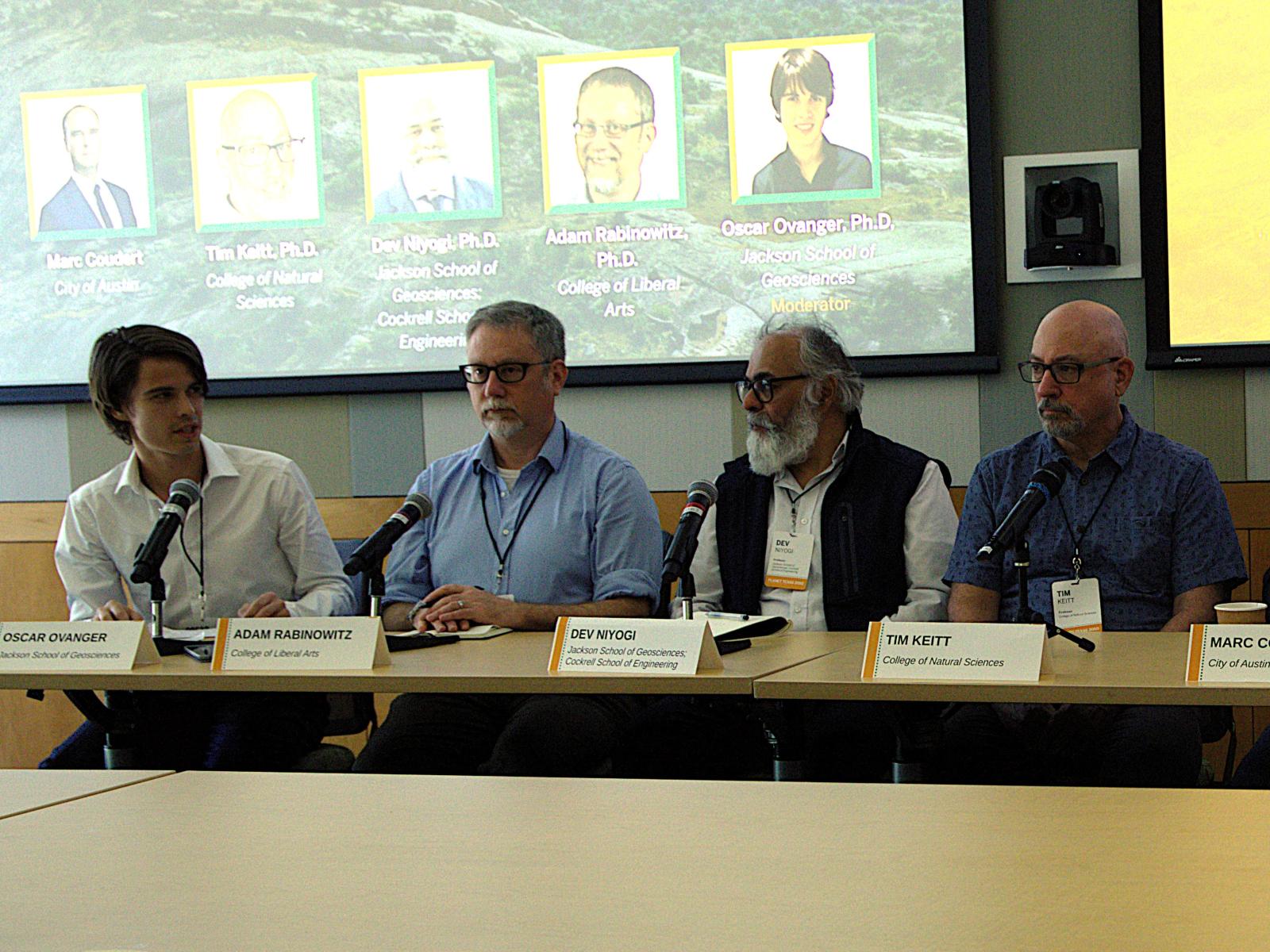
When Oscar Ovanger moved from Norway to Austin last summer, the climate adjustment was immediate.
But the transition mirrored a larger shift in his research career as well. After earning his Ph.D. in statistics through research tied to Norway’s oil and gas industry, Ovanger now applies many of those same mathematical tools to climate resilience research as a postdoctoral fellow with Planet Texas 2050.
“I feel like I kind of did a 180 in the right direction,” Ovanger said.
Ovanger was born and raised in Tromsø, in northern Norway, and earned his Ph.D. in statistics from the Norwegian University of Science and Technology, in Trondheim, where he focused on geostatistics and subsurface reservoir modeling. In 2023, while presenting at a conference, he met petroleum and geosystems engineering professor Michael Pyrcz, who invited him to UT as an exchange student.
Ovanger accepted the offer and thoroughly enjoyed the change of pace (to say nothing of the climate) of life in Texas. After finishing his Ph.D. in Norway, he returned to UT and joined Planet Texas 2050, attracted by both the initiative’s climate-focused mission and its collaborative structure. “I could have possibly done a postdoc within the oil and gas industry, but I was really drawn toward the goal itself,” he said. “I am a believer in climate change, and I thought I could make some good contributions.”
“I also liked that it was so cross-disciplinary,” he added. “I really enjoy the projects where I get to work with people from different fields.”
SOARing, RISE-ing and Fine-Tuning
As one of Planet Texas 2050’s cross-theme fellows, Ovanger will continue his work through the 2026 – 27 academic year. He currently splits his time among three different research groups.
Working with integrative biology professor Tim Keitt, who co-leads Planet Texas 2050’s Resilient Species and Ecosystems (RISE) project, he is helping develop machine learning tools that can automatically identify bird species from audio recordings collected by microphones placed in ecosystems across Texas and beyond.
The goal is to make biodiversity monitoring faster and more scalable — and to improve the accuracy of existing AI-based bird classifiers by incorporating migration data and regional bird distribution patterns. “The amount of acoustic data we’re collecting is enormous, and researchers can’t realistically process all of it manually,” Keitt said. “Oscar’s work helps move us toward scalable ecological monitoring that can operate in near real time.”
“Oscar’s work helps move us toward scalable ecological monitoring that can operate in near real time.”
— Tim Keitt, College of Natural Sciences
He is also collaborating with geosciences professor Dev Niyogi, who co-leads the UT-City Colab, on next-generation weather prediction models that use machine learning and satellite data to produce localized forecasts more efficiently than traditional supercomputer-driven approaches.
“One of the amazing opportunities with AI-driven weather modeling is that it can make forecasting of extremes faster, localized and actionable,” Niyogi said. “Oscar’s work is helping us build and bridge such capabilities and tools that help cities and neighborhoods prepare and build resilience to hazards from heat to floods.”
Rather than replacing conventional weather models entirely, the project explores how large existing AI weather systems can be fine-tuned using local data from places like Travis County. “Once these machine learning models are trained, running them can be much faster than [using] traditional methods,” Ovanger said.
A third collaboration, with archaeologist Adam Rabinowitz and the Stories of Ancient Resilience (SOAR) team, also focuses on Travis County. Ovanger has been working on what are known as heritage risk maps — tools designed to help identify archaeological and cultural sites vulnerable to flooding and other climate-related threats.
“Oscar's modeling work has been invaluable for our ability to estimate where water from heavy rains will actually end up, rather than relying only on general factors like flood-plain extent or elevation."
— Adam Rabinowitz, College of Liberal Arts
"Oscar's expertise in data modeling and integration has allowed him to develop highly detailed maps of the impact of flooding on cultural heritage resources,” Rabinowitz said. “His modeling work has been invaluable for our ability to estimate where water from heavy rains will actually end up, rather than relying only on general factors like flood-plain extent or elevation."
Because many of the cultural heritage resources are at risk, Ovanger is also exploring methods for obscuring exact site coordinates while still making the maps useful for planners and researchers. “You can think of it almost like encryption strategies,” he said.
Though his projects span ecology, climate science and archaeology, Ovanger sees common ground in all of them: using data to better understand how environments change and how people can respond. “I can see myself going in a lot of different directions,” he said of his future. “I’m open when it comes to the future of my own research and career development.”