
Planet Texas 2050 Fellow Uses Theater to Connect Hard Science with the Human Experience of Climate Change
When Winter Storm Mara swept through Central Texas in early 2023, decimating trees and knocking out power throughout Travis County, Khristián Méndez Aguirre happened to be debuting a play about — of all things — a tree that knocks down a power line and causes a motorcycle wreck. It was an art-imitating-life coincidence so uncanny that some audience members asked him whether he had adjusted the story in response to the storm.
The performance had been scheduled for months. Reality simply arrived on cue.
For Méndez Aguirre, now one of Planet Texas 2050’s first two cross-team postdoctoral fellows, the moment captured something essential about climate change: extreme events don’t just disrupt infrastructure and ecosystems — they jolt our sense of meaning, memory and connection to one another. And those human dimensions, he argues, are part of understanding climate change’s impacts on our communities.
A newly minted Ph.D. and longtime UT Austin artist-scholar in the College of Fine Arts’ Department of Theatre and Dance, Méndez Aguirre has been part of Planet Texas 2050 almost from the start. He first joined the grand challenge — what he calls his “artistic and intellectual home on campus” — in 2019, after he co-developed and pitched a project called Climate Change Dramaturgy with then-fellow Ph.D. student Nic Bennett. He later helped select PT2050’s early Artists-in-Residence and returned again a few years later to help run the Artist Fellowship.
Asking What Science Can’t
This fall, PT2050 launched its cross-team postdoctoral fellows initiative, one year after Good Systems debuted a similar program last year. The idea is to broach the shared questions and insights that link PT2050’s core projects across disparate research contexts. As one of the inaugural fellows, Méndez Aguirre has already worked with teams from three PT2050 projects: Equitable and Regenerative Cities in a Post-Carbon Future, Frontline Community Partnerships for Climate Justice and Creative Collaborations.
Méndez Aguirre’s work draws on ecodramaturgy, a field that examines how performance helps people understand environmental change. “Khristián’s expansive knowledge as an ecodramaturgy scholar and working artist helps us to effectively weave together scientific fact with personal experience and embodied knowledge in K-12 education,” said Theatre and Dance Associate Professor Katie Dawson, who has worked extensively with Méndez Aguirre. “His arts-based research methods provide multiple ways for students and teachers to make sense of and take action on local climate issues.”
"Khristián’s ecodramaturgy background gives him a unique and valuable way of seeing connections across the project teams. His work is helping us articulate the stories behind the science.”
— Katherine Lieberknecht, School of Architecture
Méndez Aguirre’s role, he said, is about weaving these efforts together. “Part of my job is looking at the information and bringing it back to context,” he said, “asking, Where does this live? What does this mean to people and the people that it’s for?”
Planet Texas 2050 co-chair Katherine Lieberknecht, who co-leads the Equitable and Regenerative Cities project, said that approach reflects the interpretive lens he brings to the work. "Khristián’s ecodramaturgy background gives him a unique and valuable way of seeing connections across the project teams,” she said. “His work is helping us articulate the stories behind the science.”
That interpretive work is central to Méndez Aguirre’s training. Scientific models must isolate variables to make them measurable. The arts, by contrast, offer tools for collective reflection and for “asking the questions that science can’t,” as he put it. “How does it feel? How might we respond to this together? And what do we need to account for that scientific frameworks cannot measure?”
Méndez Aguirre believes climate art has entered a new phase. “Most people already know climate change is happening,” he said. “We’re past the stage of just raising awareness. The question now is, what do we do with this reality?”
Hyperlocal Knowledge, Community-Based Research
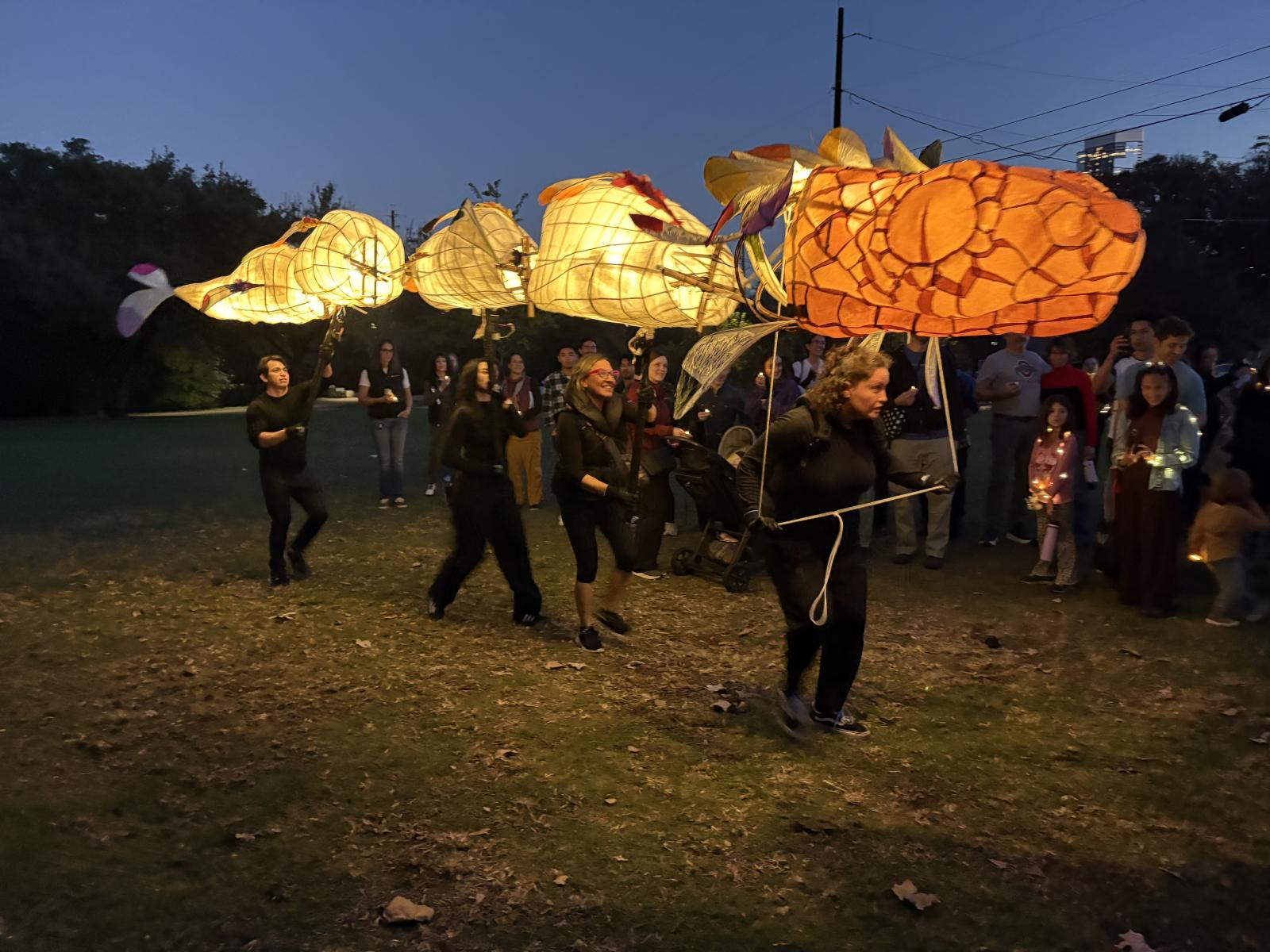
One of Méndez Aguirre’s current productions, “The Serpents Fly at Sundown” — in which a giant feathered lantern serpent puppet is used to gather stories from people who have survived natural disasters — grew from that belief. Instead of retelling their trauma for an audience, he wanted to create a space for reflection, witnessing and community ritual. “There are no public spaces to talk about or even grieve the losses that come from natural disasters,” he said. “That’s part of the work of adapting to climate change.”
Inside PT2050, his work often turns toward a recurring challenge: how to honor hyperlocal knowledge while producing insights that can matter elsewhere. He doesn’t see that as a flaw of interdisciplinary work but rather as something baked into it. “Researchers are charged with addressing a local problem,” he said. “And because we’re academics, the charge is for that solution to be useful to other people in other places who also need to solve their problems.”
“Most people already know climate change is happening. We’re past the stage of just raising awareness. The question now is, what do we do with this reality?”
— Khristián Méndez Aguirre
To that end, Méndez Aguirre is currently working on a literature review comparing case studies of community-engaged research across the Americas, including, of course, work in Texas. In all 12 case studies, he said, researchers encounter the same problem: How do they validate or improve the data they have by working with the community? “As an arts-based, community-oriented researcher, I consider their dilemmas and am able to name the intellectual assumptions and emotional frameworks that underpin those collaborations,” he said. “What a researcher or a community member assumes about research — and how they feel about it — can make or break those relationships.”
Those connections require trust, time and collaboration — qualities he sees mirrored in the arts as much as in community-engaged science. “I came to theatre because I’m interested in collaborating,” he said. “It’s hard, but the things that you can accomplish with other people are better than when you do them on your own.”