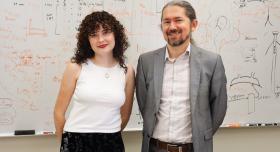
A new study led by UT researchers is the first to assess the indoor heat vulnerability for each single-family home in an entire city. The team, which included Planet Texas 2050's Dev Niyogi and Marc Coudert, found that if the power were to go out during a heatwave, 85% of Austin’s single-family homes would pose significant risk of death to an elderly person inside.
A Whole Communities–Whole Health research team has shown that HVAC filters can serve as a building-level surveillance tool. By analyzing dust collected over weeks of operation during the COVID-19 pandemic, the team detected fragments of the coronavirus and estimated how it may have been distributed across different zones of a multi-story residence hall.
For the first time, a Texas-based project has been selected for Monument Lab’s Re:Generation initiative, bringing the stories, struggles and visions of the Las Milpas neighborhood in Pharr, Texas onto the national stage.
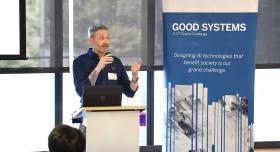
Good Systems has announced the recipients of its internal funding competition, awarding seed funding to interdisciplinary faculty teams whose projects explore how artificial intelligence can be designed in ways that better reflect human values and societal needs.
Planet Texas 2050 cross-team postdoctoral fellow Khristián Méndez Aguirre uses theater to connect hard science with the human experience of climate change.
Last year, Good Systems launched cross-cutting themes to connect its six core research projects and explore questions that span technical, ethical and social domains. One of the scholars continuing that work is postdoctoral fellow Jared Jensen, whose Knowledge, Generative AI and Power theme focuses on two interweaving concepts: how interdisciplinary teams pursue “ethical AI,” and how generative technologies are transforming creative labor and power dynamics.
A team of WCWH researchers has developed a faster, more sensitive method to analyze human hair for traces of everyday chemical exposures. By heating small hair samples and using a “sniffer” mass spectrometer to detect thousands of compounds in real time, the researchers can reveal months of a person’s exposure history — offering new possibilities for studying health and environmental risks.
Last year, UT Austin's Good Systems initiative introduced cross-cutting themes to link its six core research projects and explore questions that span multiple fields. This year, one of the researchers who launched that effort will continue his work: computer scientist Brad Knox focuses on ensuring AI systems act in ways that reflect human values, a problem known as AI alignment.
The AI+Human Objectives Initiative (AHOI) at The University of Texas at Austin has received an award from the grantmaking organization Coefficient Giving. The grant will fund AHOI’s work in the emerging field of AI alignment, which seeks to ensure that AI development is aligned with the goals and values of humanity.