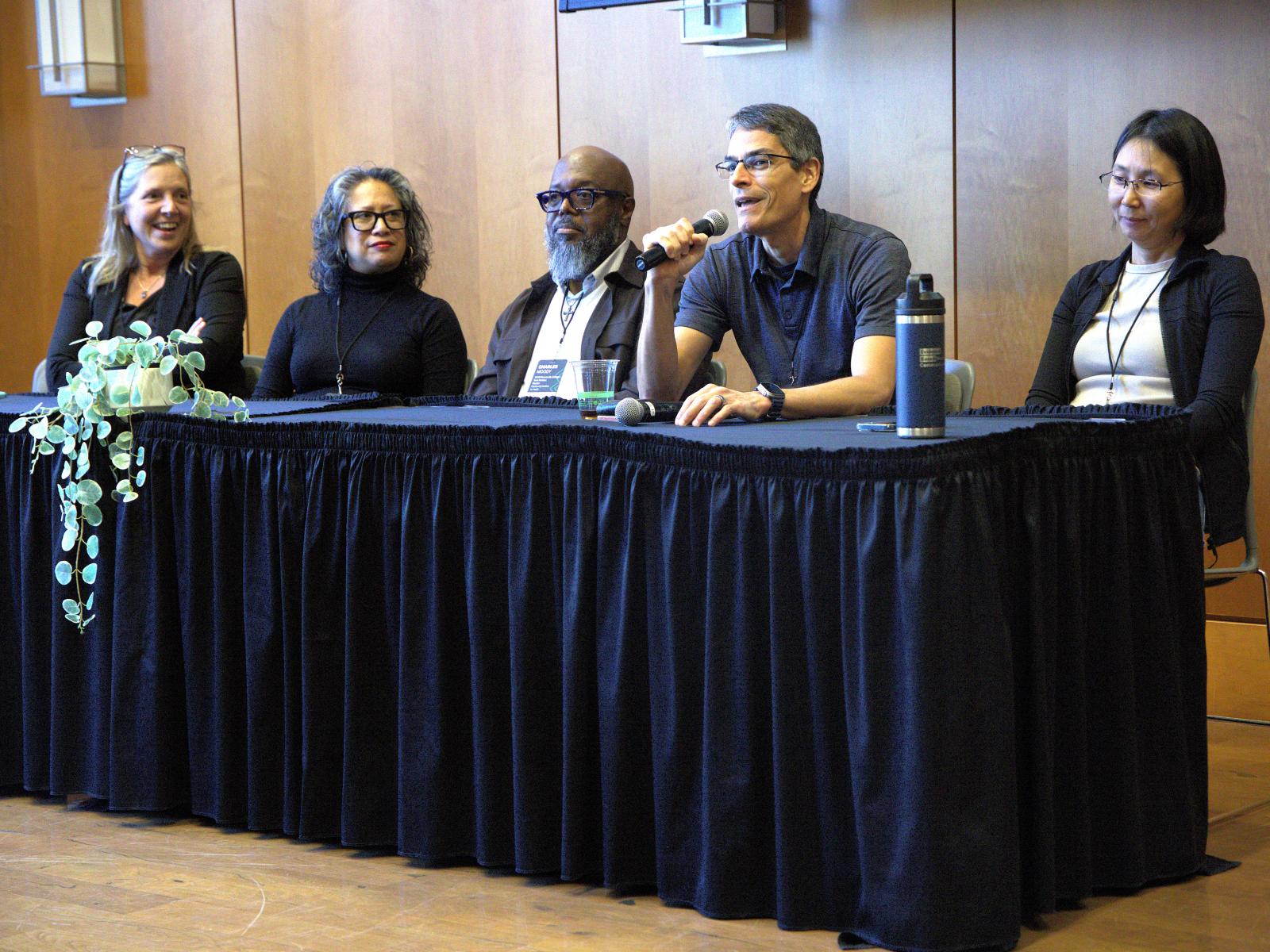
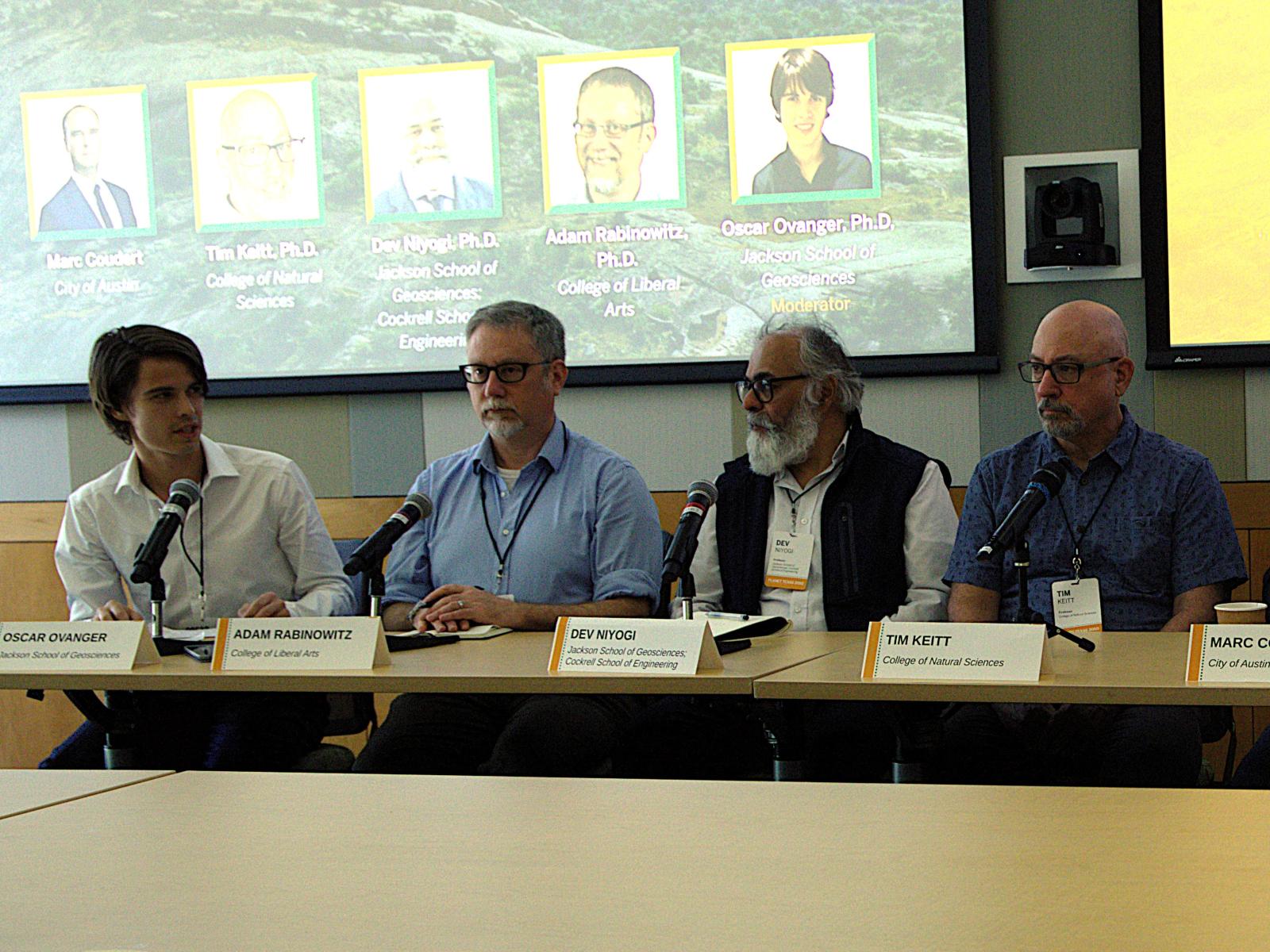
Left to right: Whole Communities–Whole Health (WCWH) chair Mike Mackert, Barbara Soriano, Ellena Gonzales, Rebecca Gomez, Mia Greer, Dr. Charles Moody and WCWH Community Engagement Manager Shirene Garcia pose at the 2026 WCWH Symposium. (Not pictured: Maggie Jaime and Carol Lilly.)
Feb. 26, 2026
Longtime Community Partners Honored at Annual Symposium

Seven longtime community partners were recently presented with Community-Engaged Research Champion Awards from Whole Communities–Whole Health (WCWH). The awards, presented at the WCWH Research Symposium on Feb. 6, honored Community Strategy Team (CST) members and community liaisons who have partnered with the initiative for five years or more and whose sustained involvement has helped guide WCWH’s flagship longitudinal study.

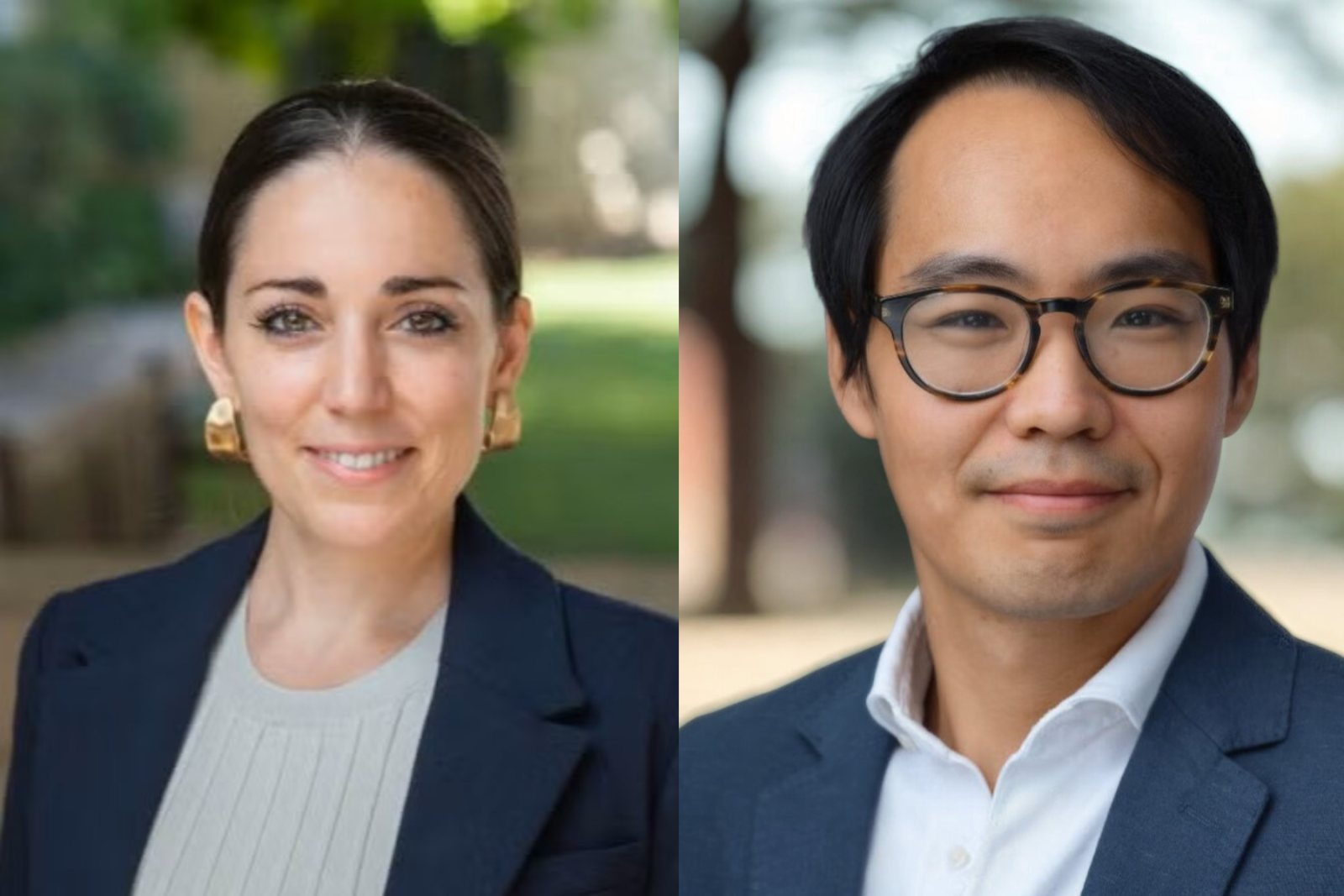
Headshots of COLA faculty awarded Good Systems seed grants. From left to right: Left to right: Yuhao Kang, Alison Kafer and Jo Hsu
Feb. 17, 2026
Seed Funding for Human-Centered AI Projects Awarded to Three COLA Faculty

Good Systems has awarded seed funding to six interdisciplinary faculty teams researching how AI can be designed in ways that better reflect human values and societal needs. Among the recipients are College of Liberal Arts faculty Yuhao Kang, Jo Hsu and Alison Kafer.

Smiling portrait of Brad Knox standing outside on campus
Feb. 11, 2026
How Can AI Companions Be Helpful, not Harmful?

A Q&A with Good Systems' Brad Knox, who researches human-computer interaction and reinforcement learning

Microscopic view of virus particles near a ventilation system highlighting concerns about airborne transmission and indoor air quality (generated with AI)
Feb. 5, 2026
Air Apparent

A Whole Communities–Whole Health research team has shown that HVAC filters can serve as a building-level surveillance tool. By analyzing dust collected over weeks of operation during the COVID-19 pandemic, the team detected fragments of the coronavirus and estimated how it may have been distributed across different zones of a multi-story residence hall.

residents' meeting
Feb. 4, 2026
From Local Advocacy to National Spotlight

For the first time, a Texas-based project has been selected for Monument Lab’s Re:Generation initiative, bringing the stories, struggles and visions of the Las Milpas neighborhood in Pharr, Texas onto the national stage.

2026 seed grant awardees
Ene. 26, 2026
Good Systems Awards Seed Grants to Six Faculty Teams Advancing Human-Centered AI

Good Systems has announced the recipients of its internal funding competition, awarding seed funding to interdisciplinary faculty teams whose projects explore how artificial intelligence can be designed in ways that better reflect human values and societal needs.

Action photo of one of Khristián Méndez Aguirre’s recent productions, “The Serpents Fly at Sundown,” which utilizes puppetry to gather stories from people who have survived natural disasters
Ene. 12, 2026
Climate Takes Center Stage

Planet Texas 2050 cross-team postdoctoral fellow Khristián Méndez Aguirre uses theater to connect hard science with the human experience of climate change.

Cross-cutting themes fellow Jared Jensen presents at Good Systems’ annual research kickoff event on September 26th.
Dic. 17, 2025
Meaning, Making and Machine Learning

Last year, Good Systems launched cross-cutting themes to connect its six core research projects and explore questions that span technical, ethical and social domains. One of the scholars continuing that work is postdoctoral fellow Jared Jensen, whose Knowledge, Generative AI and Power theme focuses on two interweaving concepts: how interdisciplinary teams pursue “ethical AI,” and how generative technologies are transforming creative labor and power dynamics.

Ph.D. student Anna Neville and Professor Pawel Misztal stand in front of a whiteboard in Misztal's office.
Dic. 9, 2025
Indoor Air, Written in Hair

A team of WCWH researchers has developed a faster, more sensitive method to analyze human hair for traces of everyday chemical exposures. By heating small hair samples and using a “sniffer” mass spectrometer to detect thousands of compounds in real time, the researchers can reveal months of a person’s exposure history — offering new possibilities for studying health and environmental risks.

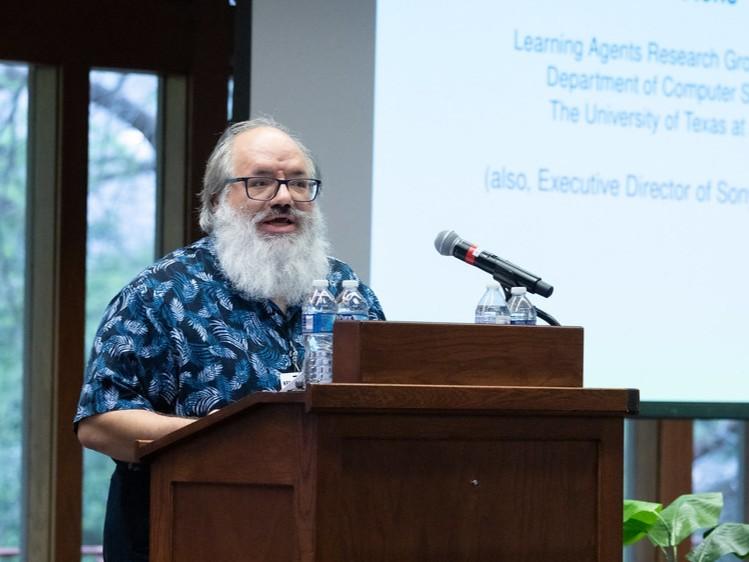
Brad Knox, a research associate professor in the Department of Computer Science, discusses AI alignment at Good Systems' annual research kickoff event, on September 26, 2025, at The University of Texas at Austin.
Nov. 24, 2025
Cross-Cutting Edge

Last year, UT Austin's Good Systems initiative introduced cross-cutting themes to link its six core research projects and explore questions that span multiple fields. This year, one of the researchers who launched that effort will continue his work: computer scientist Brad Knox focuses on ensuring AI systems act in ways that reflect human values, a problem known as AI alignment.